
In Copenhagen or online:
Couple Therapy for English-Speaking Couples
Are you struggling with conflicts, emotional distance, or the challenges of living in a new country as a couple? I’m here to help you handle these challenges as a team.
Maybe some of this sounds familiar?
You feel alone, even when you’re together.
It can seem like it’s up to you to hold everything together: to manage the practical side, start the difficult conversations, and find your way back when you drift apart. Or maybe it feels like you’re the one who’s had to sacrifice the most to make it all work. What you long for is to feel that you’re two in this, not one.
It’s hard to live away from family.
Big decisions about where to build your life and, if you have children, where to raise them, came early in your relationship. And even when the decisions are made, the distance from family and friends can wear on you over time.
You miss feeling valued.
You both do your best to make it work in a life that’s more complicated than most — with cultural differences, distance, or simply the logistics of building a life between two countries and cultures. Yet your efforts don’t always feel seen. You long for a smile, a warm glance, or a simple “thank you”.
The balance between you can shift.
Living in one partner’s home country can easily affect the sense of equality and belonging between you. How do you keep that feeling of mutual respect and closeness when one of you feels more “at home” than the other?
Imagine instead …
Talking about the hard things without it turning into a fight.
Conversations stop being battles about who’s right and become moments where you can disagree and still stay connected. You know and trust that big decisions will be taken together.
Feeling your partner at your side.
Building a life between two countries and cultures can be demanding, and the mix of languages and traditions adds extra layers to everyday life. But you know you can rely on each other. Neither of you has to carry it all alone.
Opening up about how you truly feel.
When something hurts, you can share it – without it turning into silence or conflict. It feels safe, because you know your partner listens and wants to understand.
Choosing each other, every day.
A look across the dinner table. A hand on your leg in the car. Small gestures that say you’re special to me – and with them, the quiet reassurance that you matter.
Rediscovering joy and lightness.
You laugh, tease, and enjoy each other’s company, even on an ordinary Tuesday night. You can feel at home again – not because of where you live, but because of how you are together.
“Therapy opened up conversations that used to feel impossible for us.
Places where we always got stuck are opening up.
We understand each other so much better now.”
Marie & Christian
Finding your way back to each other – in any language
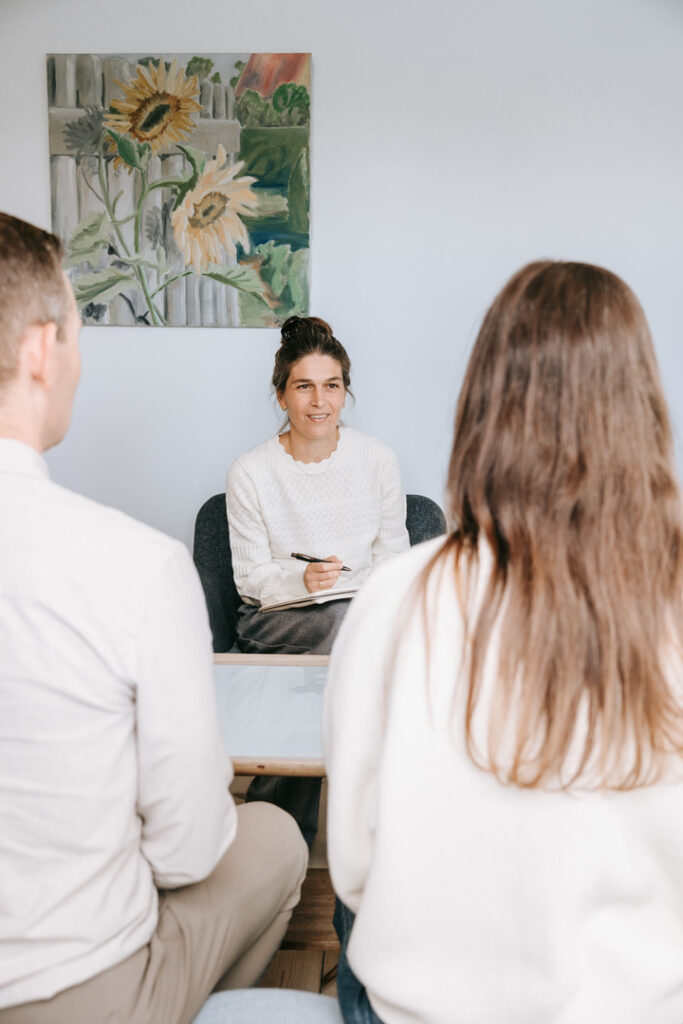
Change doesn’t happen by trying harder – it happens by understanding each other differently. That’s what we do together in therapy.
I often work with international and mixed-nationality couples who navigate the challenges of cultural differences, relocation stress, and language barriers – alongside the more familiar challenges that bring couples to therapy.
My approach is based on Emotionally Focused Therapy (EFT), which helps couples build a secure emotional bond and find new ways to reach each other when things get stuck.
Using principles from the Gottman Method, we can also include practical exercises to strengthen communication, deepen friendship, and enhance mutual understanding.
And when one of you has Danish as your first language while the other does not, but understands Danish, we often have “mixed-language sessions” so that each of you can speak in the language that feels most natural.
“Right from the start, it felt like a safe place to talk. I never felt judged or stupid – even when I couldn’t quite find the right words.”
Jacob
Space for both of you – and for what you long for
Therapy isn’t about deciding who’s “bad at relationships.” There’s no villain here. It’s about creating a space where you can both share what it actually feels like when you get stuck or pull away – and realizing that, most often, it’s really about the closeness and connection you miss.
Closer – even when you disagree
The goal of therapy isn’t to avoid conflict completely. It’s about being able to find your way back when things go wrong. To feel safe with each other – even when you disagree. And to let love and closeness be what defines your relationship.
It's the cycle that's the problem
There’s nothing wrong with either of you. And there’s nothing wrong with the two of you as a match.
What hurts is the negative cycle between you – the pattern that keeps pulling you in again and again. That’s what we work to notice and change.
Who benefits from couple therapy?
Some couples come because they’re struggling or in crisis. Others come to protect and nurture their relationship while things are still good.
Therapy isn’t only for those “on the edge.” It’s for anyone longing for more contact, understanding, and emotional safety.
And it’s common for one partner to be more skeptical. Maybe you think: “If my partner doesn’t believe in it, we’ll just waste our time.” But experience shows that even when one comes “despite doubts,” therapy can still create change. There is space for skepticism and ambivalence here. And when we look beneath it together, new conversations open up – ones that bring you closer.
Many couples also think: “It may work for others, but not for us. We’ve had this same talk a hundred times over without moving forward.” It’s natural to feel discouraged when nothing seems to help.
But therapy isn’t about trying harder. It’s about understanding each other in a new way and letting that new understanding lead to a different way of being together.
“The most important thing we’ve taken with us is shifting focus away from who’s right and wrong – and instead focusing on what each of us can do for the relationship. That gives us so much more freedom.”
Katrine & Jacob
How we work
We usually begin with a joint 90-minute session – either online or on Amager.
Then comes one individual session each (60 minutes), to better understand what you both bring into the relationship.
After that, we continue with joint sessions. Along the way, we can add some individual sessions if it feels helpful.
Therapy is a process
Many couples feel relief after the very first session – simply because it feels different to talk in a safe space.
But lasting change usually requires a process: working with patterns and practicing new ways of being together. How long it takes depends on your challenges and what else is happening in your lives right now.
Practicalities & Prices
Here you’ll find prices and practical details — and please feel free to get in touch if you have any questions.
Prices
- Couple session (90 min): 1,650 DKK.
- Individual session (60 min): 1,030 DKK.
Location
On Amager – close to DR Byen metro, with easy parking – or online via Zoom.
It can feel overwhelming to make time for therapy on top of everything else. But precisely because life is busy, it makes sense to spend a little of that time changing the way you talk together.
Many couples find that when new ways of talking open up here, things also shift at home – and conflicts take up less space.
We plan one session at a time, so there’s room for changing work hours, deadlines, and everything else that comes with daily life.
I offer sessions on weekdays during the day.Occasionally I also have late-afternoon slots – but they are few and book quickly.
Online sessions take place via a secure, encrypted Zoom link. It can be a practical option if you don’t live nearby – or if you simply prefer the comfort and flexibility of talking from your own home. In my experience, online sessions work just as well as meeting in person on Amager.
If we have scheduled an online session, you can join it here.
I am, of course, bound by confidentiality. What you share stays between us.
Life happens — if you need to cancel, please do so at least 24 hours in advance. For late cancellations, there’s a fee of 500 DKK, as it’s rarely possible to fill the slot on short notice.
“We’ve become much more open with each other. We dare say how we feel and what we need – and that makes it so much easier to navigate.
I feel more calm and safe, and I use far less energy trying to decode where we are with each other.”
Ida